
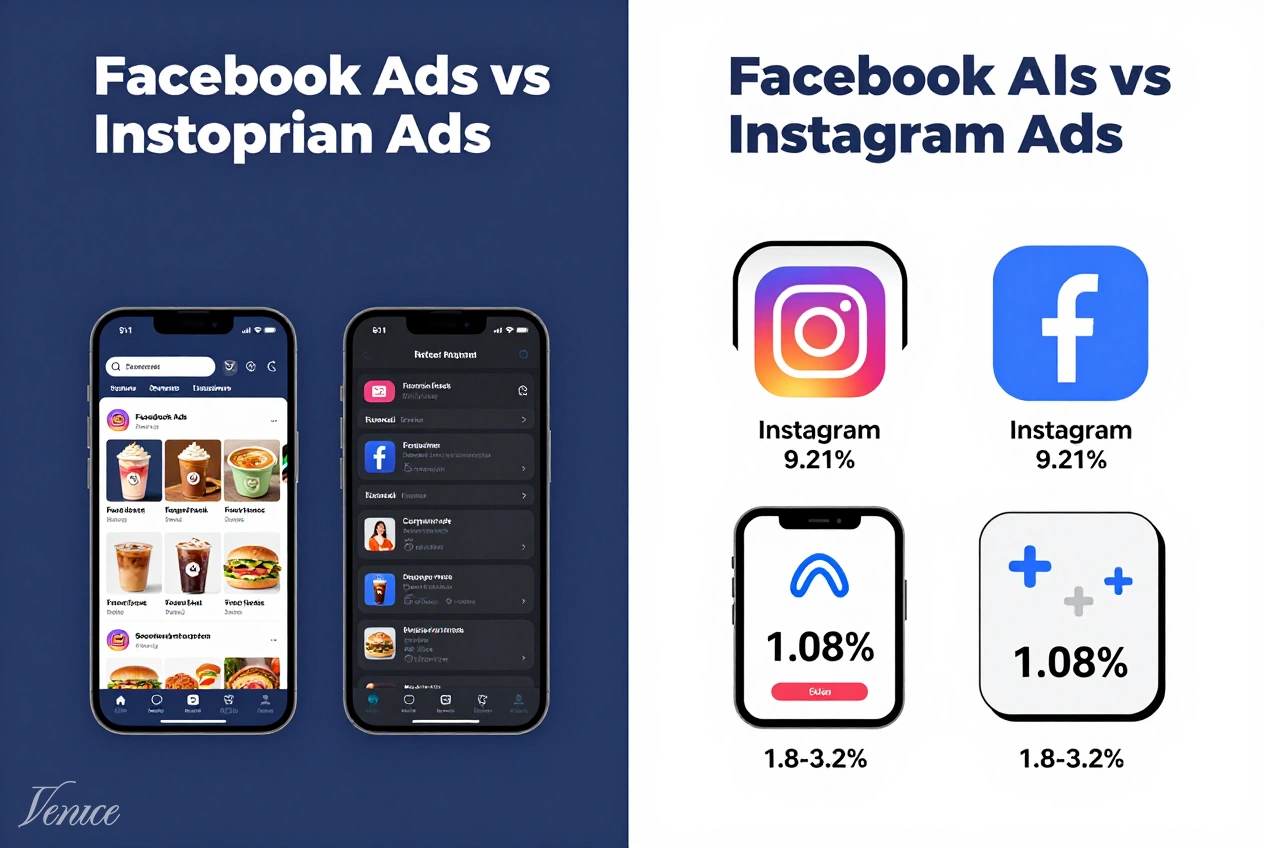
The choice between Facebook and Instagram advertising represents one of the most critical decisions for e-commerce brands looking to maximize their return on ad spend. While both platforms operate under Meta’s advertising ecosystem, they offer distinctly different user experiences, audience behaviors, and conversion pathways that can significantly impact your campaign performance. Our comprehensive analysis reveals which platform delivers superior conversions for different e-commerce scenarios and business models.
The advertising landscape has evolved dramatically in 2026, with both platforms introducing new features, targeting options, and algorithm updates that have shifted their relative effectiveness for different e-commerce objectives. Understanding these nuances is essential for allocating your marketing budget effectively and achieving optimal conversion rates across your sales funnel.
Table of Contents
Key Differences Between Facebook and Instagram Advertising
| Factor | Facebook Ads | Instagram Ads |
|---|---|---|
| User Mindset | Information-seeking, social connection | Inspiration-seeking, entertainment-focused |
| Primary Demographics | 25-65+, balanced gender distribution | 18-44, slightly female-skewed |
| Content Format | Text-heavy, multiple ad formats | Visual-first, image/video emphasis |
| Purchase Intent | Higher immediate purchase intent | Higher discovery and inspiration intent |
| Ad Placement Options | News Feed, Stories, Marketplace, Messenger | Feed, Stories, Reels, Explore, Shop |
Conversion Factors by Platform
Facebook Ads Conversion Strengths
Facebook excels at driving conversions for products with longer consideration cycles and higher price points. The platform’s detailed targeting options and diverse ad formats allow for sophisticated funnel strategies that nurture prospects through multiple touchpoints. Facebook’s retargeting capabilities are particularly effective for abandoned cart recovery and repeat customer acquisition.
The platform’s advanced pixel tracking and comprehensive analytics provide valuable insights for optimization, making it ideal for data-driven e-commerce brands focused on measurable ROI. Facebook’s user base typically demonstrates higher immediate purchase intent, especially for practical and necessity-based products.
Instagram Ads Conversion Strengths
Instagram dominates in conversions for visually-driven products, fashion, lifestyle items, and impulse purchases. The platform’s immersive visual experience creates stronger emotional connections to products, leading to higher conversion rates for aspirational and aesthetic-focused e-commerce brands. Instagram’s shopping features and seamless checkout process reduce friction in the purchase journey.
The platform’s younger, trend-conscious audience is more receptive to new product discovery and viral marketing campaigns. Instagram’s visual-first approach translates to higher engagement rates and more efficient conversion for products that benefit from visual storytelling and lifestyle integration.
Audience Analysis and Conversion Behavior
Facebook Audience Conversion Patterns
Facebook users typically approach the platform with specific information needs and are more receptive to detailed product descriptions and value propositions. The audience shows higher conversion rates for:
- Products requiring detailed specifications or comparisons
- Higher-priced items requiring consideration and research
- Practical and problem-solving products
- Products targeting older demographics (35+)
- B2B and professional products
Facebook’s conversion paths tend to be more deliberate, with users often clicking through to product pages for detailed information before purchasing. This results in longer conversion times but often higher average order values.
Instagram Audience Conversion Patterns
Instagram users are primarily in discovery mode and more likely to make impulse purchases based on visual appeal and social proof. The audience shows higher conversion rates for:
- Fashion, accessories, and aesthetic products
- Food, beauty, and lifestyle items
- Products with strong visual appeal
- Trending and viral products
- Gifts and special occasion items
Instagram’s conversion paths are typically shorter and more impulsive, with users often making quick purchasing decisions based on visual appeal and immediate desire. This results in faster conversion times but sometimes lower average order values.
Ad Format Effectiveness for E-commerce
| Ad Format | Facebook Performance | Instagram Performance | Best For |
|---|---|---|---|
| Single Image | Medium | High | Visually appealing products, lifestyle integration |
| Video Ads | High | Very High | Product demonstrations, storytelling |
| Carousel | Very High | High | Multi-feature products, collections |
| Collection | High | Very High | Product catalogs, lifestyle integration |
| Stories | Medium | High | Limited-time offers, behind-the-scenes |
| Reels | Low | Very High | Trending products, viral potential |
Cost Analysis and ROI Comparison
Facebook Ads Cost Structure
Facebook generally offers lower CPCs (Cost Per Click) and CPMs (Cost Per Mille) compared to Instagram, making it more cost-effective for driving traffic and awareness. The platform’s advanced targeting options typically result in higher quality scores, which can further reduce costs over time.
Facebook’s conversion costs tend to be more stable and predictable, with less volatility during peak shopping seasons. The platform’s extensive testing and optimization features allow for efficient budget allocation and improved ROI over time.
Instagram Ads Cost Structure
Instagram typically commands higher CPCs and CPMs due to its more engaged audience and premium ad placements. However, the platform’s higher conversion rates for certain product categories often result in superior CPA (Cost Per Acquisition) despite higher initial costs.
Instagram’s ad costs show more volatility during peak shopping seasons and trend cycles, requiring more active budget management. The platform’s visual nature often results in higher quality engagement, which can justify the increased costs for brands with strong visual assets.
Platform-Specific Conversion Strategies
Facebook Conversion Optimization Strategies
- Implement detailed retargeting sequences for abandoned carts and browsing behavior
- Use carousel ads to showcase product features and variations comprehensively
- Leverage Facebook’s lead generation forms for products requiring consideration
- Implement value-based bidding strategies to focus on high-value customers
- Utilize Facebook’s dynamic product ads for personalized recommendations
- Create custom audiences based on purchase behavior and value
- Test different ad placements to identify optimal conversion paths
Instagram Conversion Optimization Strategies
- Prioritize high-quality visual content that showcases products in lifestyle contexts
- Leverage Instagram Shopping features for seamless checkout experiences
- Use Reels and Stories for limited-time offers and flash sales
- Implement influencer partnerships to enhance social proof and credibility
- Create shoppable posts that reduce friction in the purchase journey
- Utilize user-generated content to build authenticity and trust
- Focus on mobile-optimized creative formats for on-the-go purchasing
Industry-Specific Conversion Performance
| Industry | Facebook Conversion Rate | Instagram Conversion Rate | Recommended Platform |
|---|---|---|---|
| Fashion & Apparel | 2.1% | 3.8% | |
| Electronics | 3.2% | 2.4% | |
| Home & Garden | 2.8% | 2.1% | |
| Beauty & Cosmetics | 2.5% | 3.5% | |
| Sports & Outdoors | 2.3% | 2.9% | |
| Health & Wellness | 2.7% | 3.1% |
Frequently Asked Questions
For most e-commerce brands, a dual-platform approach delivers the best results. Facebook and Instagram appeal to different user mindsets and demographics, allowing you to reach customers at different stages of their purchase journey. Start with testing both platforms with a portion of your budget, then allocate more resources to the platform that delivers better results for your specific products and audience.
Consider your product characteristics and target audience. Visually-driven products with strong lifestyle appeal typically perform better on Instagram, while practical or detailed products requiring consideration often convert better on Facebook. The most effective approach is to run small-scale tests on both platforms with identical products and compare conversion metrics before allocating significant budget.
While it’s possible to use the same creative across both platforms, performance typically suffers. Each platform has unique technical specifications and user expectations. Facebook can accommodate more text-heavy and detailed creative, while Instagram requires visually-first content with minimal text. Adapt your creative to each platform’s strengths rather than using a one-size-fits-all approach.
Instagram generally delivers better ROI for new customer acquisition due to its discovery-focused user base and higher engagement rates. However, Facebook often delivers better ROI for customer retention and repeat purchases due to its more detailed targeting options and retargeting capabilities. The most effective strategy often involves using Instagram for acquisition and Facebook for retention.
When starting out, allocate your budget evenly between both platforms (50/50 split) for the initial testing phase. Once you have sufficient data on performance metrics, reallocate budget toward the platform that delivers better results for your specific goals. For most e-commerce brands, this results in a 60/40 or 70/30 split favoring one platform over the other.
Yes, conversion patterns differ significantly between devices. Instagram is predominantly mobile-focused, with over 90% of its users accessing the platform via mobile devices. Facebook has a more balanced device distribution, with approximately 75% mobile usage. Mobile users typically convert faster but have lower average order values, while desktop users show longer consideration times but higher purchase values.
Conclusion
The choice between Facebook and Instagram advertising for e-commerce ultimately depends on your products, target audience, and business objectives. Rather than viewing them as competing platforms, savvy e-commerce brands recognize that each serves distinct purposes in the customer journey and can complement each other effectively when integrated into a comprehensive strategy.
Instagram generally delivers superior conversion rates for visually-driven products, fashion, lifestyle items, and impulse purchases, particularly among younger demographics. Facebook excels at converting higher-priced items, practical products, and audiences requiring more detailed information or consideration. The most effective approach often involves using Instagram for discovery and initial acquisition while leveraging Facebook for retention and repeat purchases.
Implement the platform-specific strategies outlined in our guide, test different approaches with controlled budgets, and analyze your performance data carefully to determine the optimal allocation for your e-commerce brand. With strategic testing and optimization, you can develop a dual-platform approach that maximizes conversions across your entire sales funnel.